International Labour Organization · World Bank Group · Circle Economy · 2025
Developing a global methodology and baseline for estimating employment associated with circular economy activities across 177 countries.
The challenge
Circular economy strategies are increasingly seen as an opportunity to improve resource efficiency while creating jobs and supporting more sustainable economic development. Yet there was limited evidence on how many people already work in the circular economy, where those jobs are located, and how employment varies across countries and sectors.
Existing approaches to measuring circular employment differed substantially, with particular gaps in coverage of developing countries, informal work and sectors where circular activities form only part of wider economic activity. The project therefore aimed to develop a globally applicable methodology and baseline that could provide a stronger evidence base for circular economy and decent work policies.
My contribution
As an economist and contributing author, I contributed across the development, analysis and interpretation of the global baseline, working closely with Circle Economy’s circular economy modelling specialists and the ILO’s jobs and labour-market experts.
My role included developing and testing the methodology, analysing and interpreting the resulting estimates, and considering their implications across countries, sectors and different dimensions of employment. I also contributed to discussions with the international advisory board, helping to test the approach and findings from wider technical and policy perspectives.
A particular area of my contribution was developing the approach for estimating circular employment in partially circular sectors, where employment cannot simply be classified as circular or non-circular. This involved combining measures of material circularity — including the use of secondary materials — with economic circularity, capturing the contribution of sectors to material recovery through domestic sales and exports.
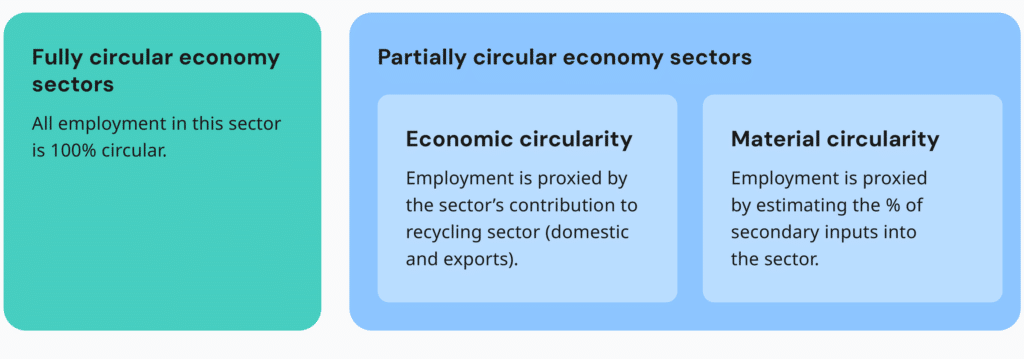
Applying this approach also involved methodological decisions around international trade, sector classification and informal employment. For partially circular sectors, including mining, manufacturing and construction, I helped determine how employment associated with production for domestic markets and exports should be attributed across countries, so that it was linked to the countries where production takes place.
These decisions required bridging technical modelling with economic analysis and the wider policy priorities of the project partners.
Findings and impact
What the analysis shows
The resulting baseline provides internationally comparable estimates of circular economy employment across 177 countries, using a methodology that combines employment statistics with economic and material-flow data.
The analysis estimates that 121–142 million people, equivalent to around 5–5.8% of global employment, are employed in the circular economy. The estimates cover both formal and informal employment and include fully and partially circular activities.
Circular economy employment is concentrated in a relatively small number of activities, with repair and maintenance accounting for 46% of circular employment and manufacturing accounting for around a quarter. The analysis also found substantial regional variation, with Asia and the Pacific accounting for more than half of global circular employment.
The estimates also highlight important limitations in the evidence base. Informal employment is captured within the methodology, but may be underestimated where employment statistics and sector classifications do not fully capture informal circular activities.
Impact
The methodology provides a common basis for measuring circular economy employment across countries and for understanding how circularity intersects with jobs, informality, gender and decent work.
The global baseline gives policymakers a starting point for integrating employment considerations into circular economy strategies, while highlighting where better data and more locally specific research are needed. It also provides a foundation for tracking changes in circular employment and considering how policies can support a transition that is not only more circular, but also productive, inclusive and decent.
Project context
The project was a collaboration between the International Labour Organization, World Bank Group and Circle Economy, with support from the UN Partnership for Action on Green Economy (PAGE) and guidance from an international advisory board. The resulting report, Employment in the Circular Economy: Leveraging circularity to create decent work, was published in December 2025.
Further reading: ILO: Employment in the circular economy · ILO: Between 121 and 142 million people are employed in the circular economy globally · UN PAGE: Measuring employment in the circular economy
Related services
Jobs, skills and the green transition
Applied research and evaluation
Economic and policy analysis
If you are looking for independent economic analysis, research expertise or specialist support within a wider project team, get in touch to discuss how I could contribute.