Eurogroup for Animals · 2023
Examining how the costs and value of higher animal-welfare standards are distributed across European supply chains.
The challenge
Higher animal-welfare standards can create additional costs for producers and other actors in agricultural supply chains. How those costs are distributed—and whether higher standards can also create value for producers—is therefore important for understanding their economic implications.
Eurogroup for Animals commissioned a set of case studies examining examples where higher animal-welfare standards had been introduced through certification and assurance schemes. The aim was to understand how additional costs were distributed across the supply chain and identify evidence of approaches that could avoid the burden falling disproportionately on farmers or consumers.
My contribution
I conducted a rapid evidence review and case-study analysis, drawing primarily on existing research and secondary sources to examine how the costs and value associated with higher welfare standards were distributed across supply chains.
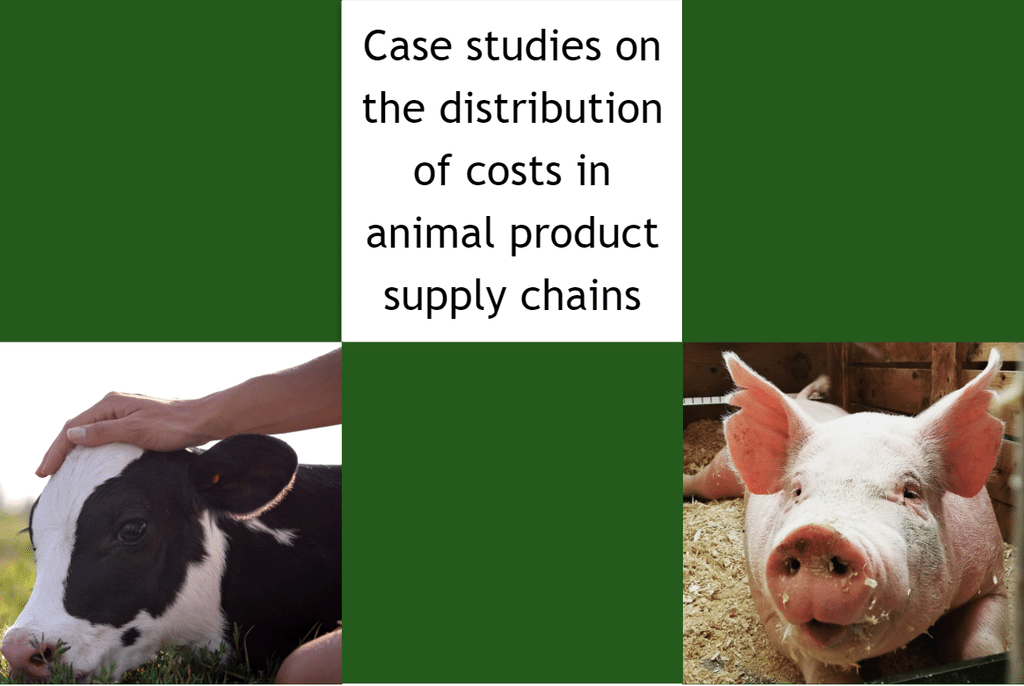
The analysis focused on two detailed European examples: Initiative Tierwohl, a higher-welfare pig scheme in Germany, and Welfair®, a certification system for higher-welfare dairy production in Spain.
I synthesised evidence on the additional costs faced by producers, the mechanisms used to compensate or reward them, and the implications for prices and other actors in the supply chain. I also drew on evidence from other initiatives, including GM-free products, organic milk and livestock transport, to identify wider lessons about how higher standards can be financed.
The work required bringing together evidence from a range of existing sources and translating it into concise, comparable case studies for a policy audience.
Findings and impact
The German case showed how retailers and processors can use fees and guaranteed prices to compensate farmers for most of the additional costs of higher welfare standards, while maintaining little or no observed difference in consumer prices.
In the Spanish dairy case, the median additional cost of improving animal welfare was estimated at around €0.003 per litre, or less than 1% of average farmer costs. The value associated with certification was greater than the additional cost for the median farmer in the evidence reviewed.
Together, the cases showed that the economic implications of higher standards depend not only on the size of additional costs, but on how costs and value are distributed across the supply chain.
The evidence provided practical examples of how retailers, processors and other supply-chain actors can help prevent the costs of higher standards from falling disproportionately on farmers or consumers.
Project context
The project was commissioned by Eurogroup for Animals as part of its work to develop evidence on the economic implications of higher animal-welfare standards.
Given the short timeframe, the analysis was based predominantly on secondary research, drawing together existing evidence from academic, industry and policy sources and earlier research.
The resulting case studies were intended to provide accessible evidence for policy and stakeholder engagement around the economic implications of higher animal-welfare standards.
Related services:
Trade, sustainability and economic transformation
Applied research and evaluation
If you are looking for independent economic analysis, research expertise or specialist support within a wider project team, get in touch to discuss how I could contribute.